
Boundary Committee
This webpage will be regularly updated to keep our community informed about the progress of the district's 2026 boundary review process and the work of CCSD93's Boundary Committee.
🌐 Para traducir este sitio web, utiliza el botón de traducción con la bandera que aparece abajo.
CCSD93 Boundary Review Community Input Night
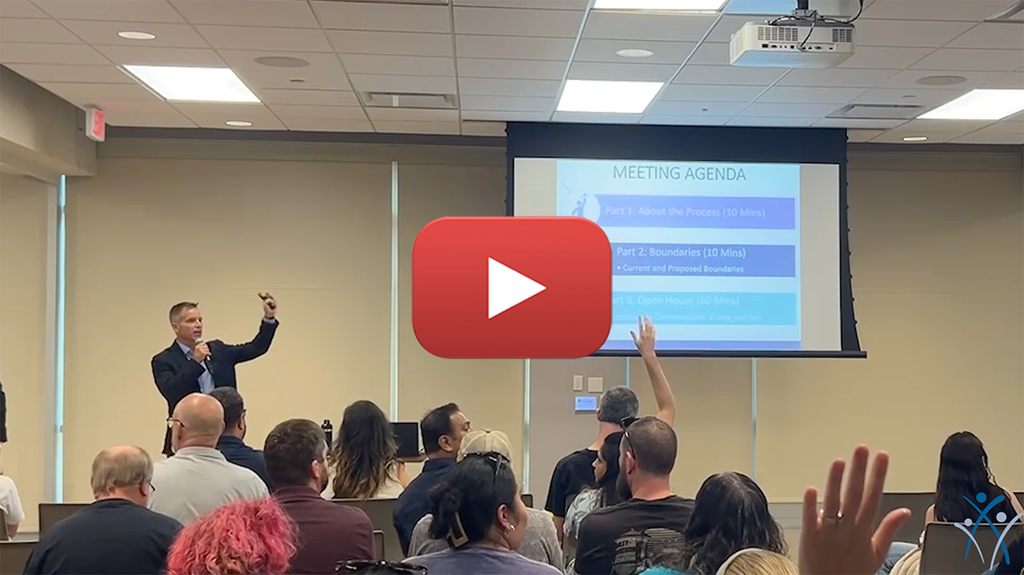
Watch the CCSD93 Boundary Review - Community Input Night Presentation from September 1, 2026, here:
Para ver este video de la presentación de la Noche de Participación Comunitaria en español, haga clic aquí.
Additional CCSD93 Boundary Review video resources:
Frequently Asked Questions Document – September 1, 2026 Community Input Night Q&A
The document linked here includes questions posed during the September 1, 2026 Community Input Night and the district’s responses. These questions also reflect many of the common topics and concerns CCSD93 has heard from community members throughout the boundary review process. While some questions have been edited for clarity, consistency and readability, the intent and substance of each question have been preserved.
En español: Este documento incluye preguntas de la comunidad y respuestas del distrito sobre la revisión de límites de CCSD93. Algunas preguntas se editaron para mayor claridad y consistencia, sin cambiar su intención ni contenido.
Timeline
This timeline graphic lays out the steps and timeline of the boundary review process. It will be updated as the process progresses.

Para ver la cronología en español, haga clic aquí.
Take Survey & Explore Boundary Committee Resource Website
CCSD93's school planning expert partners RSP & Associates have established a site for CCSD93's Boundary Committee, which will remain up-to-date with key resources, including the 5-Year Enrollment Analysis, meeting presentations, boundary proposals, a community survey and more.
THE PUBLIC IS INVITED TO EXPLORE THIS BOUNDARY COMMITTEE RESOURCE WEBSITE AT HTTPS://RSP.MYSOCIALPINPOINT.COM/CCSD-93-BOUNDARY-STUDY.
Committee Membership
At the request of members of the CCSD93 Board of Education, this document provides additional information about the composition of the 2026-27 Boundary Committee, including members’ associated school areas and how they were appointed.
Updates From CCSD93
Linked below are CCSD93's boundary review communications to our community, with the most recent open by default. Expand the sections below to view previous updates
- CCSD93 Boundary Review Update: Community Feedback Results & New Proposed Concept - 10/2/26
- CCSD93 Boundary Review: Complete Survey by 9/18 & Watch Presentation - 9/2/26
- Invitation: Attend CCSD93 Boundary Review Community Input Night on 8/31 or 9/1
- Save the Date for CCSD93 Boundary Review Community Input Nights 8/31 & 9/1 - 8/7/26 (Sent via Enews)
- Planning for the Future: CCSD93 Boundary Review Process Begins - 7/1/26
- Updated CCSD93 Boundary Review Process Begins This Summer - 5/27/26
CCSD93 Boundary Review Update: Community Feedback Results & New Proposed Concept - 10/2/26
Dear CCSD93 Community,
CCSD93’s Boundary Committee met this week to review the results of our recent community survey and continue its work toward potential boundary recommendations.
As a direct result of community feedback and the committee’s continued analysis, a new Proposed Concept has been developed for consideration. No recommendation has been made, and the Boundary Committee has determined that it will meet again in October to continue its work before finalizing a recommendation for consideration by district leadership and ultimately the Board of Education.
Keeping the Focus on Equitable Student Experiences
As this work continues, it is important to keep the full purpose of the boundary review in focus. Declining enrollment, available capacity across our schools and the district’s financial outlook all make it necessary to consider how CCSD93 can better align its facilities and resources with the number of students we serve.
While those realities make this work necessary, the primary goal of any boundary modifications is to provide equitable educational opportunities for students across CCSD93. As the Boundary Committee considers how attendance boundaries can best support students across our schools, this means providing comparable access to appropriate class sizes, academic programming, specialists, extracurricular activities and other opportunities.
What We Heard From the Community
Thank you to the 1,265 individuals whose valid responses were included in the Boundary Review Community Survey. The results provided clear direction about both what the community valued in the original concepts and where respondents wanted the committee to continue its work.
Among the results:
- 58% of respondents supported Concept 1, compared with 19% who supported Concept 2, 6% who supported both and 17% who supported neither.
- Middle school enrollment balance remained an important concern. Open-ended comments repeatedly suggested retaining Concept 1's elementary boundaries while reconsidering the middle school boundaries, including multiple suggestions for a hybrid of Concept 1 Elementary and Concept 2 or revised middle school boundaries.
- Minimizing disruption was a clear priority. Support for Concept 1 frequently centered on minimizing the number of students and families affected.
- Other recurring themes included transportation and travel time, class sizes, staffing and programming, preserving school communities, financial benefits, transition supports and potential grandfathering.
Note: As part of its review of the survey data, RSP identified more than 700 submissions originating from the same IP address at intervals of approximately one minute. After consultation with the survey platform provider, RSP determined that these submissions represented automated activity intended to disproportionately influence the results. One submission was retained and the remaining submissions were excluded. The 1,265 valid responses reported above reflect that adjustment.
How Community Feedback Informed the Proposed Concept
The Boundary Committee used the survey results and continued analysis to consider how it could address middle school enrollment balance while also responding to the community’s strong preference for minimizing student disruption.
The resulting Proposed Concept combines key elements of the two concepts previously presented to the community:
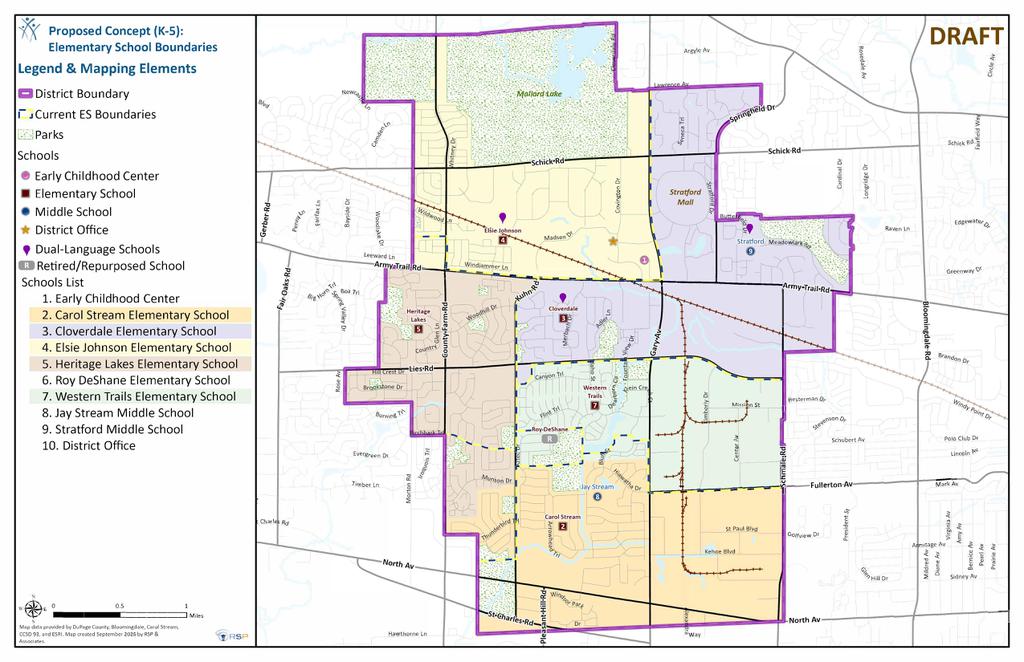
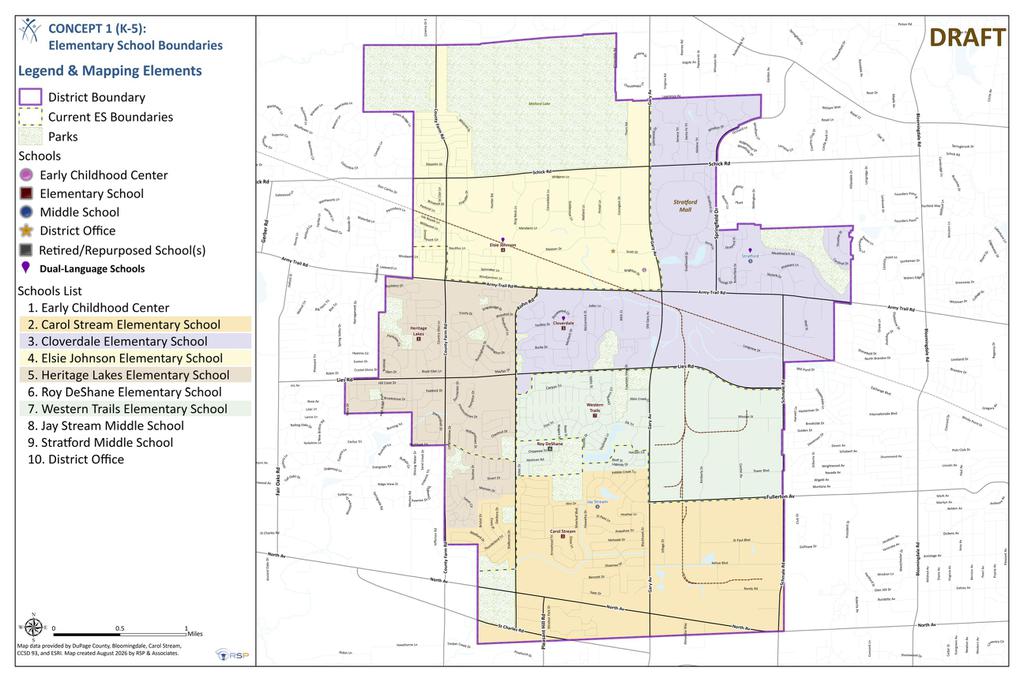
- At the elementary level, the Proposed Concept maintains the boundaries from Elementary Concept 1. This includes the retirement of Roy DeShane Elementary School, with its students reassigned among Western Trails, Heritage Lakes and Carol Stream elementary schools, along with additional boundary adjustments throughout the district. This approach received considerably greater community support, minimizes the number of elementary students changing schools and is projected to maintain consistent class sizes within existing district guidelines across our elementary schools.
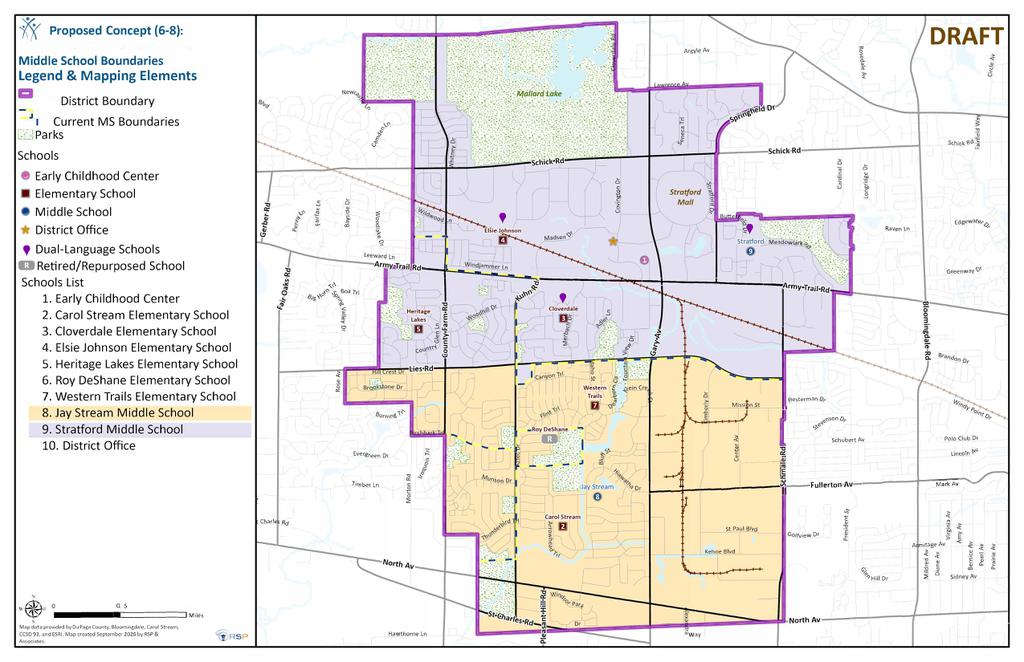
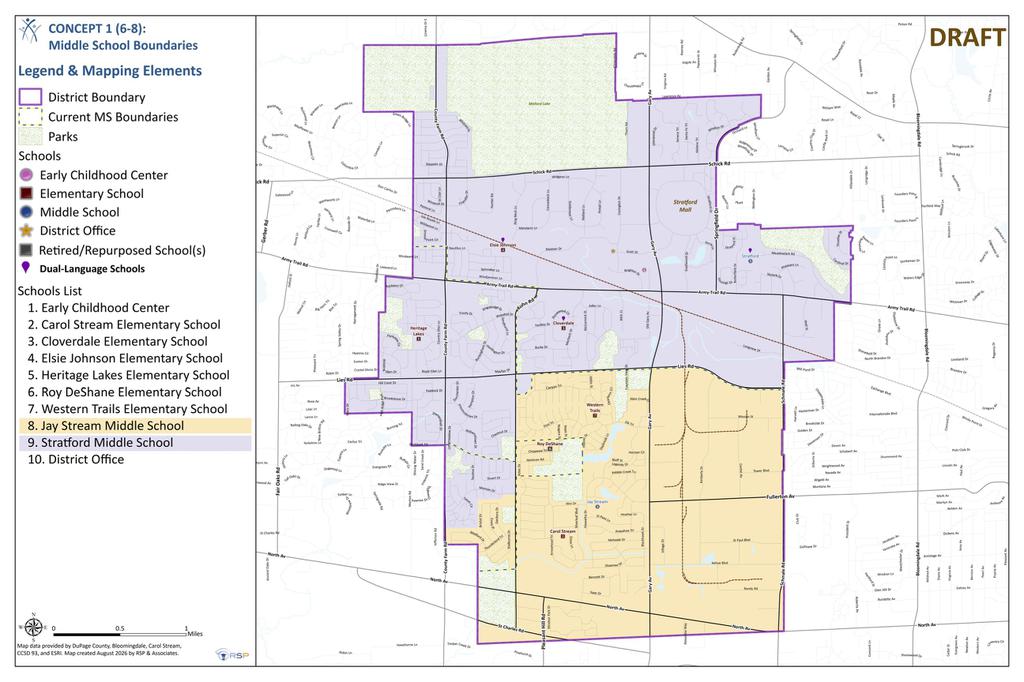
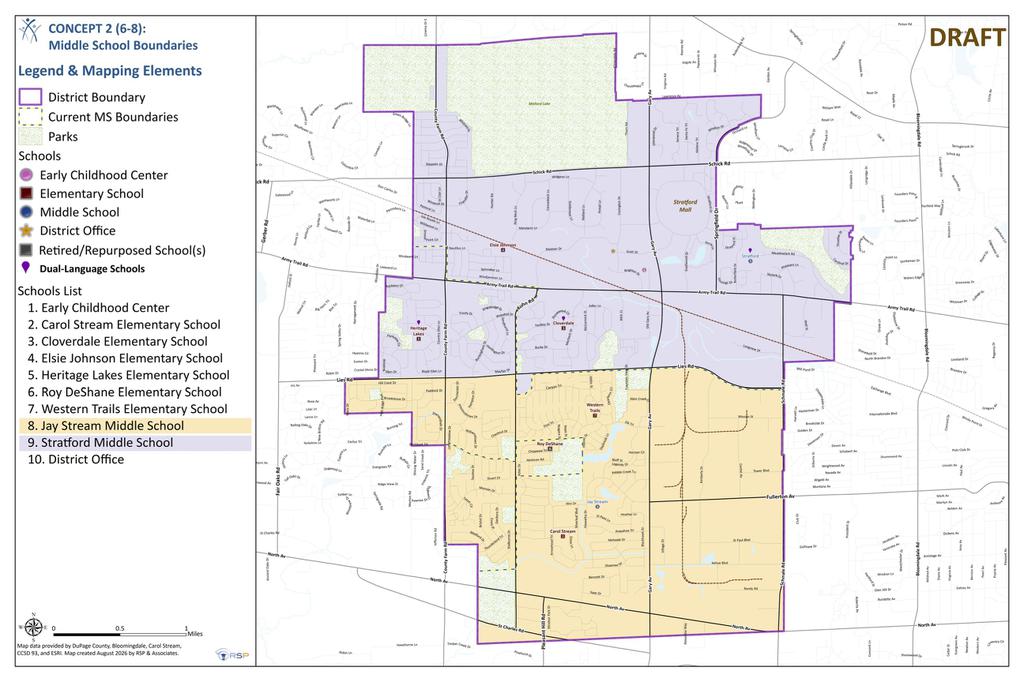
- At the middle school level, the Proposed Concept incorporates the general approach from Middle School Concept 2, intended to create more equitable enrollment between Jay Stream and Stratford. Under the current Proposed Concept, portions of the Heritage Lakes attendance area would feed into both middle schools, with Lies Road serving as the proposed dividing line.
This combination directly reflects themes identified through the community survey.
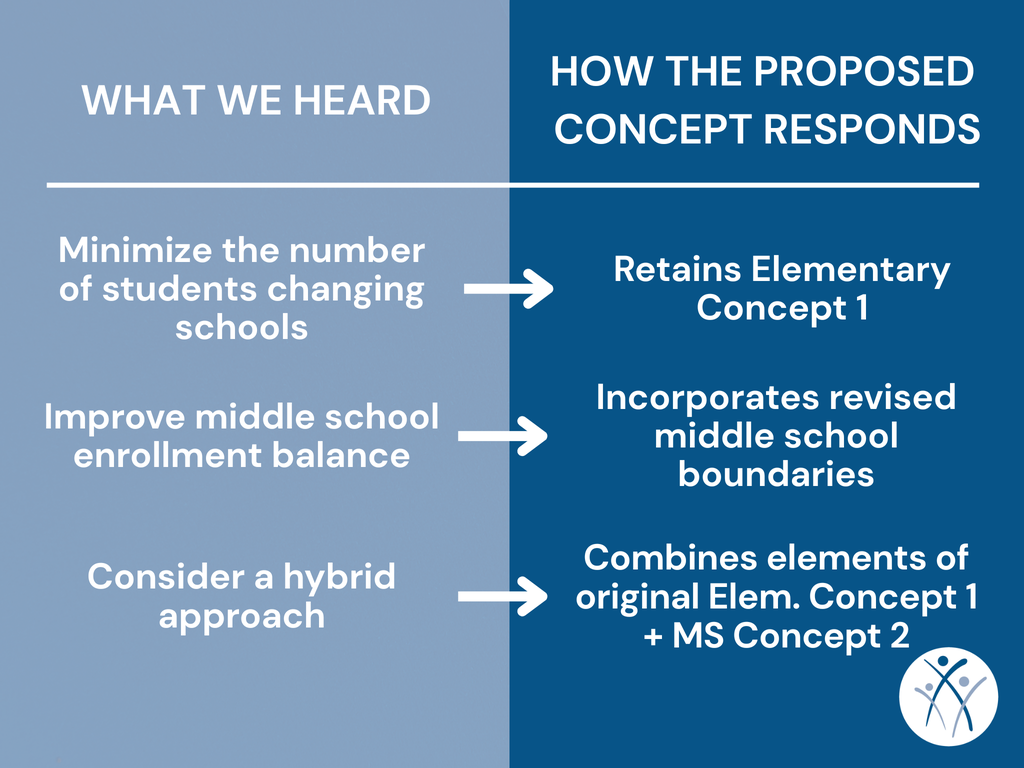
The Proposed Concept represents an effort to balance priorities that do not perfectly align: minimizing disruption to students and families while creating more equitable and sustainable enrollment between our middle schools. In developing it, the committee sought a compromise that responds to community feedback while continuing to address the Board of Education’s priorities and guiding principles for the boundary review.
At the bottom of this email, you can find elementary and middle school boundary maps for the new Proposed Concept. Interactive versions of the maps, previous Boundary Committee meeting materials, survey results and additional background information are available on RSP & Associates’ CCSD93 Boundary Study webpage.
Why Middle School Enrollment Balance Matters
We recognize that changing established feeder patterns can affect students, families and school communities, and the committee does not consider that tradeoff lightly. At the same time, significant differences in middle school enrollment can create meaningful differences in the educational and extracurricular experiences available to students.
More balanced enrollment between Jay Stream and Stratford does not mean the schools must have identical enrollment or identical programs. Rather, avoiding a substantial enrollment disparity helps provide students with equitable opportunities regardless of which CCSD93 middle school they attend, particularly in two areas:
- Classes and academic programming: Middle school scheduling depends on having enough students to create appropriately sized and sustainable class sections. Significant enrollment differences can result in very small classes at one school and much larger classes at the other. In some cases, lower enrollment can also make it difficult to offer a particular course, elective or level of programming at one school that can be sustained at the other. Students should not have meaningfully different academic opportunities simply because of which CCSD93 middle school they attend.
- Extracurricular opportunities: Band, orchestra, clubs, athletics and other activities also depend on sufficient student participation. A significant enrollment disparity can make it more difficult to sustain certain activities, teams or robust programs at the smaller school while those same opportunities are more readily available at the larger school. More balanced enrollment helps ensure students at both middle schools have access to comparable opportunities beyond the classroom.

Using RSP’s current enrollment projection model, the two concepts produce notably different middle school enrollment patterns:
- Original Concept 1: Approximately 400 students would attend Jay Stream and 700 students would attend Stratford, resulting in Stratford enrolling about 75% more students than the other.
- Proposed Concept: Approximately 565 students would attend Jay Stream and 535 would attend Stratford, resulting in substantially more balanced middle school enrollment.
As part of the committee’s continued work, CCSD93 and RSP are reviewing and refining these projections using more current October enrollment data and other factors that may affect future enrollment patterns. While the exact projected enrollments may change through that process, current analyses consistently show a significantly more balanced distribution under the Proposed Concept.
Ultimately, middle school enrollment balance is not about making two numbers identical. It is about creating the conditions for students at both schools to have comparable access to classes, programs and activities. The Proposed Concept represents an effort to balance that goal with another clear priority expressed through community feedback: minimizing disruption to students and families, while continuing to address the Board of Education’s priorities and guiding principles for this work.
What Happens Next
The Proposed Concept is not a final recommendation from the committee, and no final boundary decision has been made. The boundary review will continue over the coming weeks, with the following key next steps:
- October Boundary Committee meeting: The committee will continue reviewing the Proposed Concept, enrollment and utilization data, transportation considerations and other relevant information before finalizing its recommendation.
- Potential grandfathering: We have heard questions about allowing some students affected by boundary changes to remain at their current schools for a period of time. Potential grandfathering provisions will be discussed after the Board of Education makes a final decision on any boundary modifications. Until then, the district cannot determine which students might be eligible or what transportation arrangements could accompany them.
- October 29 Board meeting: Following the committee’s remaining work, a recommendation is expected to be presented to the Board of Education for consideration.
- 2027-28 school year: Any Board-approved boundary changes would take effect no earlier than the 2027-28 school year.
- Stay informed: Visit www.ccsd93.com/bc for the updated timeline, previous communications and additional resources, including access to RSP & Associates’ Boundary Study site.
We understand the far-reaching impact that potential boundary changes can have on students, families and our broader community, and these are not changes we would pursue or take lightly. At the same time, we have a responsibility to address the enrollment and fiscal realities facing our district and provide equitable learning opportunities for students across all CCSD93 schools.
Sincerely,
David H. Hill, Ed.D.
Superintendent
Community Consolidated School District 93
Estimada comunidad de CCSD93,
El Comité de Límites del CCSD93 se reunió esta semana para revisar los resultados de nuestra reciente encuesta comunitaria y continuar su trabajo para posibles recomendaciones sobre los límites.
Como resultado directo de los comentarios de la comunidad y del análisis continuo del comité, se ha elaborado un nuevo concepto propuesto para su consideración.No se ha formulado ninguna recomendación, y el Comité de Límites ha decidido reunirse de nuevo en octubre para continuar su trabajo antes de finalizar una recomendación que será considerada por la dirección del distrito y, en última instancia, por la Junta de Educación.
Mantener el enfoque en experiencias estudiantiles equitativas
A medida que este trabajo avanza, es importante mantener presente el objetivo principal de la revisión de límites.La disminución de la matrícula, la capacidad disponible en nuestras escuelas y las perspectivas financieras del distrito hacen necesario considerar cómo CCSD93 puede alinear mejor sus instalaciones y recursos con la cantidad de estudiantes a los que atendemos.
Si bien estas realidades hacen que este trabajo sea necesario, el objetivo principal de cualquier modificación de los límites es brindar oportunidades educativas equitativas para los estudiantes en todo el distrito escolar CCSD93.A medida que el Comité de Límites Escolares considera cómo los límites de asistencia pueden brindar el mejor apoyo a los estudiantes de todas nuestras escuelas, esto implica proporcionar un acceso comparable a tamaños de clase adecuados, programas académicos, especialistas, actividades extracurriculares y otras oportunidades.
Lo que escuchamos de la comunidad
Agradecemos a las 1265 personas cuyas respuestas válidas se incluyeron en la Encuesta Comunitaria sobre la Revisión de Límites. Los resultados proporcionaron una guía clara sobre lo que la comunidad valoraba en los conceptos originales y sobre dónde deseaban los encuestados que el comité continuara su labor.
Entre los resultados:
- El 58% de los encuestados apoyó el Concepto 1., en comparación con el 19% que apoyó el Concepto 2, el 6% que apoyó ambos y el 17% que no apoyó ninguno.
- El equilibrio en la matrícula de las escuelas secundarias seguía siendo una preocupación importante.En los comentarios abiertos se sugirió repetidamente mantener los límites de la escuela primaria del Concepto 1 mientras se reconsideraban los límites de la escuela intermedia, incluyendo varias sugerencias para un híbrido de los límites de la escuela primaria del Concepto 1 y del Concepto 2, o límites revisados para la escuela intermedia.
- Minimizar las interrupciones era una prioridad clara.El apoyo al Concepto 1 se centraba con frecuencia en minimizar el número de estudiantes y familias afectadas.
- Otros temas recurrentes incluyeron el transporte y el tiempo de viaje, el tamaño de las clases, el personal y la programación, la preservación de las comunidades escolares, los beneficios financieros, el apoyo a la transición y la posible aplicación de cláusulas de derechos adquiridos.
Nota: Como parte de su revisión de los datos de la encuesta, RSP identificó más de 700 envíos provenientes de la misma dirección IP con intervalos de aproximadamente un minuto. Tras consultar con el proveedor de la plataforma de encuestas, RSP determinó que estos envíos representaban actividad automatizada destinada a influir desproporcionadamente en los resultados. Se conservó un envío y se excluyeron los demás. Las 1265 respuestas válidas mencionadas anteriormente reflejan este ajuste.
Cómo la retroalimentación de la comunidad influyó en el concepto propuesto.
El Comité de Límites utilizó los resultados de la encuesta y el análisis posterior para considerar cómo podría abordar el equilibrio en la matrícula de las escuelas secundarias, al tiempo que respondía a la marcada preferencia de la comunidad por minimizar las interrupciones en la vida estudiantil.
El concepto propuesto resultante combina elementos clave de los dos conceptos presentados previamente a la comunidad:
- En el nivel elementalEl concepto propuesto mantiene los límites del Concepto 1 para escuelas primarias. Esto incluye la eliminación de la Escuela Primaria Roy DeShane, cuyos alumnos serán reubicados entre las escuelas primarias Western Trails, Heritage Lakes y Carol Stream, además de otros ajustes de límites en todo el distrito. Este enfoque recibió un apoyo comunitario considerablemente mayor, minimiza el número de alumnos de primaria que cambian de escuela y se prevé que mantenga un tamaño de clase uniforme, de acuerdo con las directrices vigentes del distrito, en todas nuestras escuelas primarias.
- A nivel de escuela secundariaEl concepto propuesto incorpora el enfoque general del Concepto 2 para escuelas secundarias, con el objetivo de lograr una matrícula más equitativa entre Jay Stream y Stratford. Según el concepto propuesto actual, parte del área de influencia de Heritage Lakes se distribuiría entre ambas escuelas secundarias, con Lies Road como la línea divisoria propuesta.
Esta combinación refleja directamente los temas identificados a través de la encuesta a la comunidad.
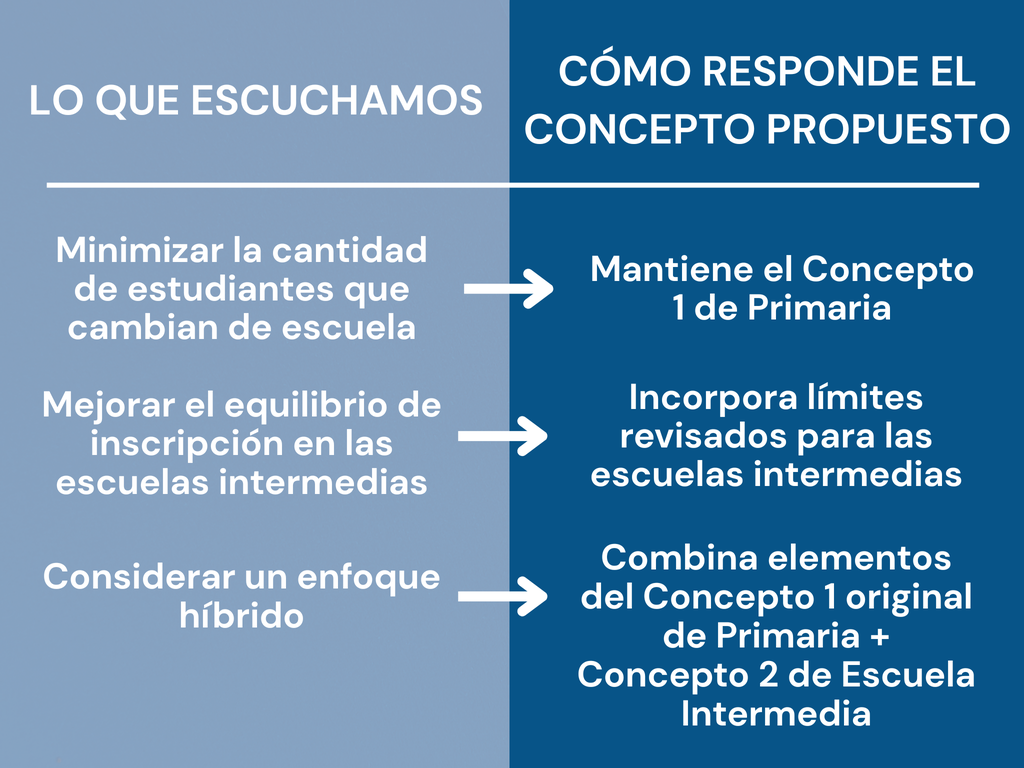
El concepto propuesto representa un esfuerzo por equilibrar prioridades que no coinciden perfectamente:Minimizar las molestias para los estudiantes y sus familias, a la vez que se crea una matrícula más equitativa y sostenible entre nuestras escuelas intermedias. Al elaborarlo, el comité buscó un compromiso que respondiera a las opiniones de la comunidad, sin dejar de abordar las prioridades y los principios rectores de la Junta de Educación para la revisión de los límites escolares.
Al final de este correo electrónico, encontrará los mapas de límites de las escuelas primarias y secundarias correspondientes al nuevo concepto propuesto.Las versiones interactivas de los mapas, los materiales de las reuniones anteriores del Comité de Límites, los resultados de las encuestas y la información de antecedentes adicional están disponibles enPágina web del estudio de límites del CCSD93 de RSP & Associates.
Por qué es importante el equilibrio en la matrícula de las escuelas secundarias
Reconocemos que modificar los patrones de acogida establecidos puede afectar a los estudiantes, las familias y las comunidades escolares, y el comité no considera esa disyuntiva a la ligera.Al mismo tiempo, las diferencias significativas en la matrícula de la escuela secundaria pueden generar diferencias importantes en las experiencias educativas y extracurriculares disponibles para los estudiantes.
Una matrícula más equilibrada entre Jay Stream y Stratford no significa que las escuelas deban tener una matrícula idéntica o programas idénticos. Más bien,Evitar una disparidad sustancial en la matrícula ayuda a brindar a los estudiantes oportunidades equitativas independientemente de a qué escuela secundaria del CCSD93 asistan, particularmente en dos áreas:
- Clases y programas académicos:La organización de los horarios en la escuela secundaria depende de contar con suficientes estudiantes para crear grupos de clase adecuados y sostenibles. Las diferencias significativas en la matrícula pueden resultar en clases muy pequeñas en una escuela y clases mucho más grandes en otra. En algunos casos, una menor matrícula también puede dificultar la oferta de un curso, una asignatura optativa o un nivel de programa específico en una escuela que sí se pueda mantener en la otra.Los estudiantes no deberían tener oportunidades académicas significativamente diferentes simplemente por la escuela secundaria del distrito escolar CCSD93 a la que asisten.
- Oportunidades extracurriculares:Las bandas musicales, las orquestas, los clubes, los deportes y otras actividades también dependen de una participación estudiantil suficiente. Una disparidad significativa en la matrícula puede dificultar el mantenimiento de ciertas actividades, equipos o programas sólidos en la escuela más pequeña, mientras que esas mismas oportunidades están más fácilmente disponibles en la escuela más grande.Una matrícula más equilibrada ayuda a garantizar que los estudiantes de ambas escuelas secundarias tengan acceso a oportunidades comparables fuera del aula.

Utilizando el modelo de proyección de matrícula actual de RSP, los dos conceptos producen patrones de matrícula en la escuela secundaria notablemente diferentes:
- Concepto original 1:Aproximadamente 400 estudiantes asistirían a Jay Stream y 700 estudiantes asistirían a Stratford, lo que resultaría en que Stratford matriculara alrededor de un 75% más de estudiantes que la otra.
- Concepto propuesto:Aproximadamente 565 estudiantes asistirían a Jay Stream y 535 a Stratford, lo que resultaría en una matrícula de secundaria sustancialmente más equilibrada.
Como parte del trabajo continuo del comité, CCSD93 y RSP están revisando y perfeccionando estas proyecciones utilizando datos de matriculación de octubre más recientes y otros factores que podrían afectar los patrones de matriculación futuros. Si bien las cifras exactas de matriculación proyectadas podrían variar durante este proceso, los análisis actuales muestran consistentemente una distribución significativamente más equilibrada según el Concepto Propuesto.
En definitiva, lograr un equilibrio en la matrícula de las escuelas secundarias no consiste en igualar las cifras, sino en crear las condiciones para que los estudiantes de ambas escuelas tengan un acceso comparable a clases, programas y actividades.El concepto propuesto representa un esfuerzo por equilibrar ese objetivo con otra prioridad clara expresada a través de los comentarios de la comunidad: minimizar las molestias a los estudiantes y las familias, al tiempo que se siguen abordando las prioridades y los principios rectores de la Junta de Educación para este trabajo.
¿Qué sucede después?
El concepto propuesto no es una recomendación final del comité, y aún no se ha tomado una decisión definitiva sobre los límites.La revisión de los límites continuará durante las próximas semanas, con los siguientes pasos clave:
- Reunión del Comité de Límites de octubre:El comité continuará revisando el concepto propuesto, los datos de matriculación y utilización, las consideraciones de transporte y otra información relevante antes de finalizar su recomendación.
- Posible cláusula de derechos adquiridos:Hemos recibido preguntas sobre la posibilidad de que algunos estudiantes afectados por los cambios de límites escolares permanezcan en sus escuelas actuales durante un tiempo. Se analizarán posibles disposiciones transitorias una vez que la Junta de Educación tome una decisión final sobre cualquier modificación de límites. Hasta entonces, el distrito no puede determinar qué estudiantes podrían ser elegibles ni qué arreglos de transporte podrían acompañarlos.
- Reunión de la junta directiva del 29 de octubre:Una vez finalizado el trabajo restante del comité, se espera que se presente una recomendación a la Junta de Educación para su consideración.
- Año escolar 2027-28:Cualquier cambio en los límites escolares aprobado por la Junta entraría en vigor no antes del año escolar 2027-28.
- Manténgase informado: Visita www.ccsd93.com/bcPara obtener el cronograma actualizado, las comunicaciones anteriores y recursos adicionales, incluido el acceso al sitio del Estudio de Límites de RSP & Associates.
Comprendemos el profundo impacto que los posibles cambios en los límites escolares pueden tener en los estudiantes, las familias y nuestra comunidad en general, y no son cambios que tomaríamos a la ligera. Al mismo tiempo, tenemos la responsabilidad de abordar la situación financiera y de matriculación que enfrenta nuestro distrito y brindar oportunidades de aprendizaje equitativas para los estudiantes en todas las escuelas del CCSD93.
Atentamente,
David H. Hill, Doctor en Educación.
Superintendente
Distrito Escolar Consolidado Comunitario 93
CCSD93 Boundary Review: Complete Survey by 9/18 & Watch Presentation - 9/2/26
Dear CCSD93 Community,
Thank you to everyone who attended this week’s Community Input Nights regarding CCSD93’s ongoing boundary review. We appreciate the questions, perspectives and thoughtful discussion shared by members of our community.
For those who were unable to attend, or anyone who would like to revisit the information presented, you can find a video of the September 1 Community Input Night presentation online here or by clicking the image below. The presentation provides important background on the district’s current enrollment and financial realities, as well as the two draft boundary concepts currently under consideration. You can also visit www.ccsd93.com/bc to view recordings of the community Q&A sessions that followed the presentation on both nights.
Para ver una versión en español del video de la presentación de la Noche de Participación Comunitaria, haga clic aquí.
Why This Work Is Taking Place
As we have shared throughout the boundary review process, CCSD93 is seeking to provide equitable learning opportunities for students while making responsible use of the financial resources and facilities entrusted to us by our community.
Enrollment Decline
An important part of that discussion is that CCSD93 is serving significantly fewer students than it once did. The graph below shows elementary and middle school enrollment since 2001, including the district’s peak of more than 5,100 combined students in 2002, through today. Historical enrollment is based on publicly available data, while 2026 reflects enrollment at the end of the 2025-26 school year and 2027 reflects enrollment following the first week of the current 2026-27 school year.
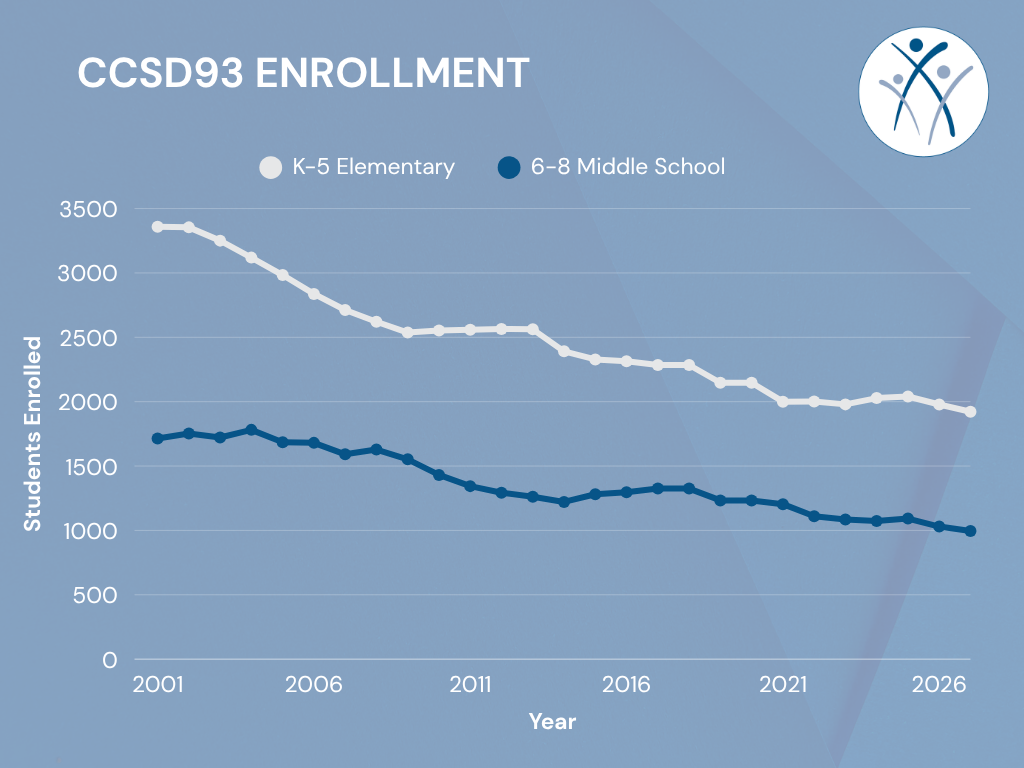
At our peak, CCSD93’s six elementary schools alone served more than 3,350 students. Today, we consider approximately 2,900 students to be a comfortable combined capacity for those same six buildings, yet they currently serve fewer than 2,000. Enrollment is projected to remain relatively flat or decline slightly over the next five years, even after accounting for anticipated new housing developments within our boundaries.
Those students are also not distributed evenly across our schools. As a result, some buildings have considerably more available classroom space than others, while the district continues to operate and maintain all six elementary schools. Aligning our facilities and resources more closely with the number of students we serve is therefore an important part of this review.
Operating Costs Outpacing Revenue
CCSD93 is also facing significant financial pressure as operating costs increasingly outpace revenue. Like families and businesses throughout our community, the district continues to experience the effects of inflation on salaries, benefits, transportation, utilities, supplies, insurance and other expenses. These costs do not decline proportionately as student enrollment decreases.
At the same time, growth in several major revenue sources is limited or declining. Federal funding available to school districts has decreased from the elevated levels available in recent years, while Illinois law generally limits annual growth in property tax extensions on existing property to the lesser of 5% or the January consumer price index figure determined by the Federal Bureau of Labor Statistics, which is currently 2.7%. Certain state reimbursements for expenses such as transportation and special education also continue to cover only a portion of districts’ eligible costs.
Together, these factors have resulted in CCSD93 spending more than it is currently taking in. We have the financial resources to manage a short-term deficit, but continuing on this trajectory would significantly reduce the district’s fund balance over time.
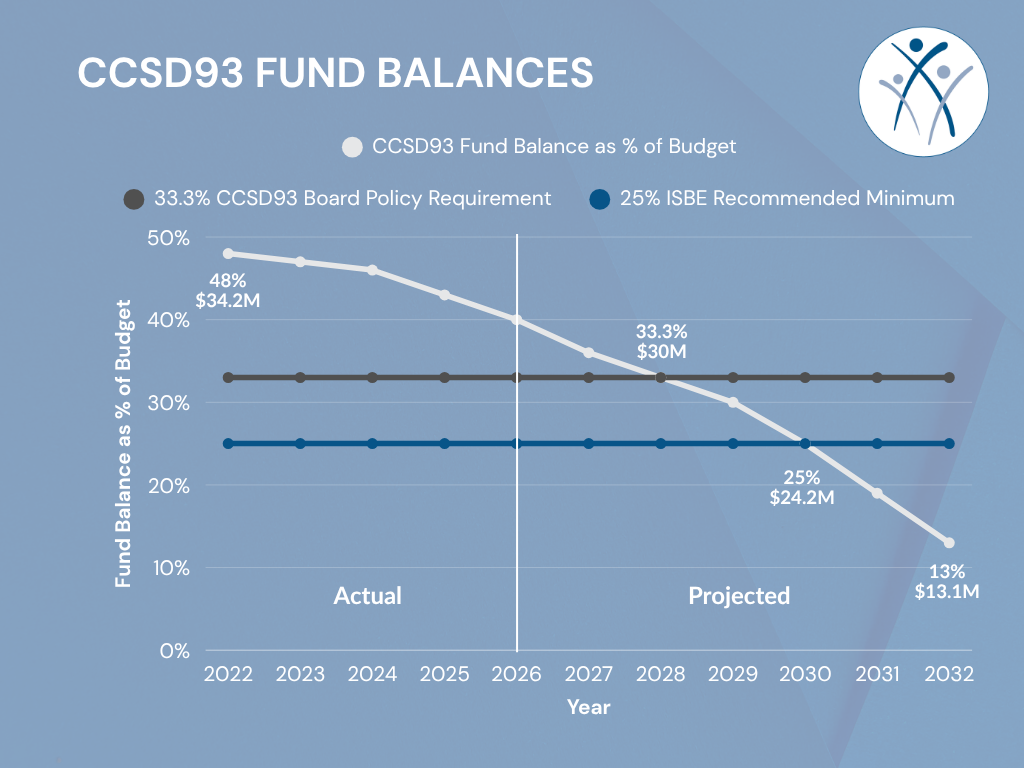
The graph below illustrates the projected decline in CCSD93’s fund balance from FY2022 (2021-22 school year) through FY2032 (2031-32 school year). A fund balance functions somewhat like a savings account, providing reserves that help the district maintain cash flow while awaiting revenue and respond to unexpected financial needs. Without thoughtful and sustainable cost reductions, CCSD93’s fund balance is projected to decline to approximately 13% of its total budget by FY2032, well below the 25% fund balance level recognized by the Illinois State Board of Education as a strong financial position and the 33.3% that CCSD93’s Board Policy requires.
This trajectory must be addressed to support the district’s long-term financial stability. CCSD93 is working to reduce costs throughout all areas of the district, and we must continue making thoughtful and responsible reductions while prioritizing the academic, social and emotional needs of every student.
This is why the boundary review is about more than where individual boundary lines are drawn. It is an opportunity to consider how CCSD93 can better align its schools, staffing and resources with the number of students we serve while maintaining equitable access to learning spaces, specialists and programs.
Review the Information & Share Your Feedback by 9/18
During the Community Input Nights, school planning experts from RSP & Associates presented two boundary concepts developed with the Boundary Committee for community consideration:
- Concept 1 includes the retirement of Roy DeShane Elementary School.
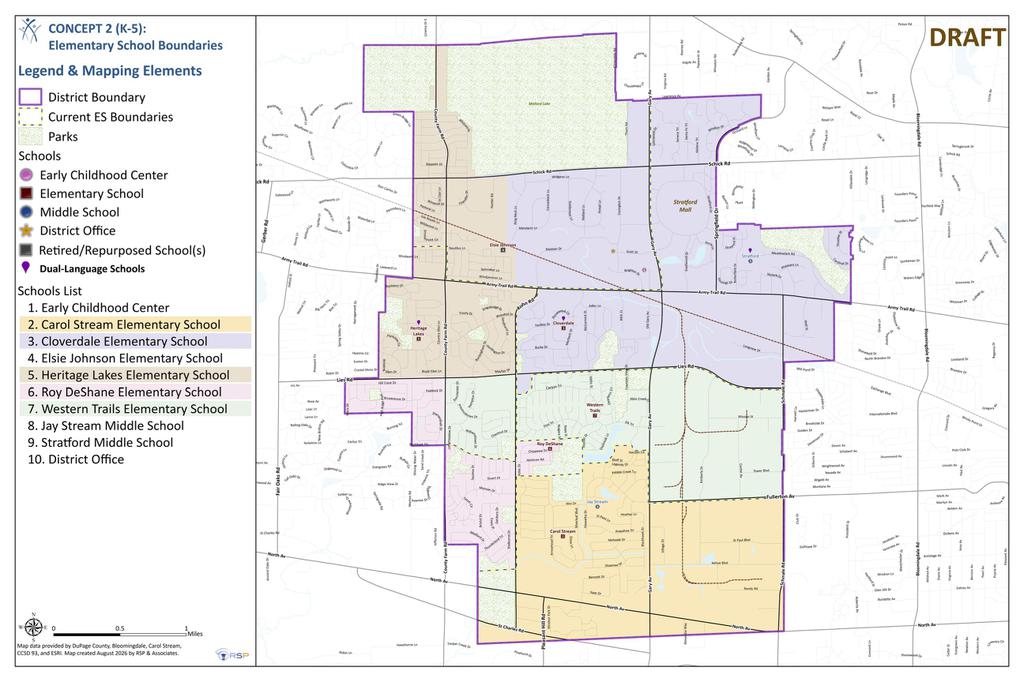
- Concept 2 includes the retirement of Elsie Johnson Elementary School.
Neither concept represents a final recommendation. To become fully informed and provide feedback as the Boundary Committee continues its work, we encourage you to:
- Review the presentation and community Q&A: Watch the presentation video linked above and recordings of the Q&A sessions from both Community Input Nights at CCSD93’s Boundary Review webpage.
- Explore the concepts and supporting information: Visit RSP’s CCSD93 Boundary Study website for interactive maps, Boundary Committee presentations, the 5-Year Enrollment Analysis and additional resources.
- Most importantly, please complete the community survey by September 18.
The survey is the primary and most effective way for families, staff and community members to formally share feedback for consideration by the Boundary Committee. Whether or not you attended a Community Input Night or have shared your perspective in another way, we encourage you to complete the survey so your feedback can be included as the committee continues its work.
What Happens Next
Following the survey, the Boundary Committee will review community feedback alongside the concepts and other relevant information as it considers whether to make a recommendation to the Board of Education. Survey results will also be shared with the community. Any resulting recommendation that could impact student enrollment boundaries would be presented to the Board at the October 29 School Board meeting. Any Board-approved changes would take effect no earlier than the 2027-28 school year.
For the latest information throughout this work, including the presentation video, timeline, previous district communications and links to RSP & Associates’ study materials, please visit CCSD93’s Boundary Review webpage.
Thank you for taking the time to learn about this important work and share your perspective as we seek to provide equitable opportunities for CCSD93 students while remaining responsible stewards of community resources. We understand the far-reaching impact that changes to school boundaries can have on students, families and our broader community, and these are not changes we want to make or take lightly. At the same time, we have a responsibility to address the enrollment and financial realities facing our district in a thoughtful and sustainable way.
Sincerely,
David H. Hill, Ed.D.
Superintendent
Community Consolidated School District 93
Estimada comunidad de CCSD93,
Gracias a todos los que asistieron a las Jornadas de Participación Comunitaria de esta semana sobre la revisión de límites del distrito escolar CCSD93. Agradecemos las preguntas, las perspectivas y el análisis constructivo que compartieron los miembros de nuestra comunidad.
Para quienes no pudieron asistir, o para quienes deseen repasar la información presentada, pueden encontrar un video de la presentación de la Noche de Participación Comunitaria del 1 de septiembre.en línea aquío haciendo clic en la imagen de abajo.La presentación proporciona información importante sobre la matrícula actual del distrito y la situación financiera, así como sobre los dos borradores de conceptos de límites que se están considerando actualmente. También puede visitarwww.ccsd93.com/bcpara ver las grabaciones de las sesiones de preguntas y respuestas con la comunidad que siguieron a la presentación ambas noches.
Por qué se está llevando a cabo este trabajo.
Como hemos compartido a lo largo del proceso de revisión de límites, el CCSD93 busca brindar oportunidades de aprendizaje equitativas para los estudiantes, haciendo un uso responsable de los recursos financieros y las instalaciones que nuestra comunidad nos ha confiado.
Disminución de la matrícula
Una parte importante de ese debate es que el distrito escolar CCSD93 atiende a un número significativamente menor de estudiantes que antes.El gráfico que aparece a continuación muestra la matrícula de primaria y secundaria desde 2001, incluyendo el pico del distrito de más de 5100 estudiantes combinados en 2002, hasta la actualidad. La matrícula histórica se basa en datos disponibles públicamente, mientras que 2026 refleja la matrícula al final del año escolar 2025-26 y 2027 refleja la matrícula después de la primera semana del actual año escolar 2026-27.
En su mejor momento, las seis escuelas primarias del distrito escolar CCSD93 atendían a más de 3350 estudiantes. Hoy en día, consideramos que aproximadamente 2900 estudiantes es una capacidad combinada adecuada para esos mismos seis edificios, pero actualmente atienden a menos de 2000.Se prevé que la matrícula se mantenga relativamente estable o disminuya ligeramente durante los próximos cinco años, incluso teniendo en cuenta los nuevos proyectos de vivienda previstos dentro de nuestros límites.
Estos estudiantes tampoco están distribuidos de manera uniforme entre nuestras escuelas. Como resultado, algunos edificios cuentan con mucho más espacio disponible en las aulas que otros, mientras que el distrito continúa operando y manteniendo las seis escuelas primarias. Por lo tanto, ajustar nuestras instalaciones y recursos al número de estudiantes que atendemos es una parte importante de esta revisión.
Los costos operativos superan los ingresos.
El distrito escolar CCSD93 también se enfrenta a una importante presión financiera, ya que los costes operativos superan cada vez más los ingresos.Al igual que las familias y las empresas de nuestra comunidad, el distrito sigue sufriendo los efectos de la inflación en salarios, prestaciones, transporte, servicios públicos, suministros, seguros y otros gastos. Estos costos no disminuyen proporcionalmente a medida que disminuye la matrícula estudiantil.
Al mismo tiempo, el crecimiento de varias fuentes de ingresos importantes es limitado o está disminuyendo.Los fondos federales disponibles para los distritos escolares han disminuido con respecto a los elevados niveles de los últimos años, mientras que la ley de Illinois generalmente limita el crecimiento anual de las prórrogas del impuesto predial sobre las propiedades existentes al menor de los siguientes valores: el 5 % o el índice de precios al consumidor de enero, determinado por la Oficina Federal de Estadísticas Laborales, que actualmente se sitúa en el 2,7 %. Ciertos reembolsos estatales para gastos como transporte y educación especial también siguen cubriendo solo una parte de los costos elegibles de los distritos.
En conjunto, estos factores han provocado que el distrito escolar CCSD93 gaste más de lo que ingresa actualmente.Contamos con los recursos financieros para gestionar un déficit a corto plazo, pero continuar por este camino reduciría significativamente el saldo de fondos del distrito con el tiempo.
El siguiente gráfico ilustra la disminución proyectada del saldo de fondos del CCSD93 desde el año fiscal 2022 (año escolar 2021-22) hasta el año fiscal 2032 (año escolar 2031-32).El saldo de un fondo funciona de forma similar a una cuenta de ahorros, proporcionando reservas que ayudan al distrito a mantener el flujo de caja mientras espera ingresos y a responder a necesidades financieras imprevistas.Sin reducciones de costos bien pensadas y sostenibles, se prevé que el saldo de fondos del CCSD93 disminuya a aproximadamente el 13% de su presupuesto total para el año fiscal 2032, muy por debajo del nivel de saldo de fondos del 25% reconocido por la Junta Estatal de Educación de Illinois como una posición financiera sólida y del 33,3% que exige la Política de la Junta del CCSD93.
Es necesario abordar esta tendencia para respaldar la estabilidad financiera a largo plazo del distrito.El distrito escolar CCSD93 está trabajando para reducir los costos en todas las áreas del distrito, y debemos continuar realizando reducciones reflexivas y responsables, priorizando al mismo tiempo las necesidades académicas, sociales y emocionales de cada estudiante.
Por eso, la revisión de los límites escolares va más allá de simplemente trazar las líneas divisorias individuales. Es una oportunidad para considerar cómo el CCSD93 puede alinear mejor sus escuelas, personal y recursos con la cantidad de estudiantes que atiende, manteniendo al mismo tiempo un acceso equitativo a los espacios de aprendizaje, especialistas y programas.
Revise la información y comparta sus comentarios antes del 18/9.
Durante las Noches de Participación Comunitaria, los expertos en planificación escolar de RSP & Associates presentaron dos conceptos de límites desarrollados con el Comité de Límites para su consideración por parte de la comunidad:
- Concepto 1Incluye la jubilación de la escuela primaria Roy DeShane.
- Concepto 2incluye la jubilación de la escuela primaria Elsie Johnson.
Ninguno de los dos conceptos constituye una recomendación definitiva.Para estar plenamente informado y poder ofrecer sus comentarios a medida que el Comité de Límites continúa su labor, le animamos a que:
- Revisa la presentación y la sección de preguntas y respuestas de la comunidad:Vea el video de presentación enlazado arriba y las grabaciones de las sesiones de preguntas y respuestas de ambas noches de participación comunitaria enPágina web de revisión de límites del CCSD93.
- Explora los conceptos y la información complementaria: Visita Sitio web del estudio de límites del distrito escolar CCSD93 de RSPPara mapas interactivos, presentaciones del Comité de Límites, el Análisis de Matrícula de 5 Años y recursos adicionales.
- Lo más importante, por favorCompletar la encuesta comunitariaPara el 18 de septiembre.
La encuesta es la principal y más eficaz manera para que las familias, el personal y los miembros de la comunidad compartan formalmente sus opiniones para que el Comité de Límites las tenga en cuenta.Tanto si asistió a una sesión informativa comunitaria como si compartió su punto de vista de otra manera, le animamos a que complete la encuesta para que sus comentarios se tengan en cuenta mientras el comité continúa con su trabajo.
¿Qué sucede después?
Tras la encuesta, el Comité de Límites revisará las opiniones de la comunidad junto con los conceptos y demás información relevante para decidir si presenta una recomendación a la Junta de Educación. Los resultados de la encuesta también se compartirán con la comunidad. Cualquier recomendación que pudiera afectar los límites de matrícula estudiantil se presentará a la Junta en la reunión del 29 de octubre. Los cambios aprobados por la Junta entrarán en vigor a partir del año escolar 2027-28.
Para obtener la información más reciente sobre este trabajo, incluyendo el video de presentación, el cronograma, las comunicaciones previas del distrito y los enlaces a los materiales de estudio de RSP & Associates, visitePágina web de revisión de límites del CCSD93.
Gracias por dedicar tiempo a conocer esta importante labor y compartir su perspectiva mientras buscamos brindar oportunidades equitativas a los estudiantes del CCSD93, a la vez que gestionamos de manera responsable los recursos de la comunidad. Entendemos el profundo impacto que los cambios en los límites escolares pueden tener en los estudiantes, las familias y nuestra comunidad en general, y no son cambios que queramos realizar ni tomar a la ligera. Al mismo tiempo, tenemos la responsabilidad de abordar la matrícula y la situación financiera de nuestro distrito de manera reflexiva y sostenible.
Atentamente,
David H. Hill, Doctor en Educación.
Superintendente
Distrito Escolar Consolidado Comunitario 93
Invitation: Attend CCSD93 Boundary Review Community Input Night on 8/31 or 9/1
Dear CCSD93 Community,
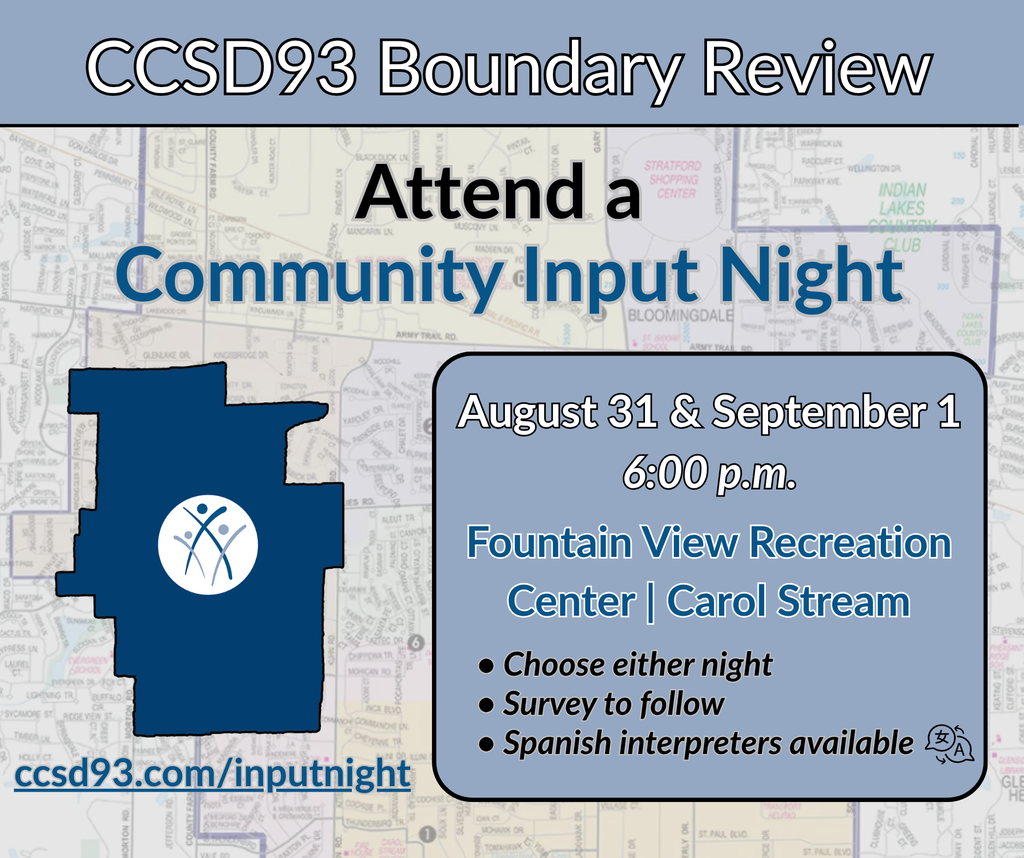
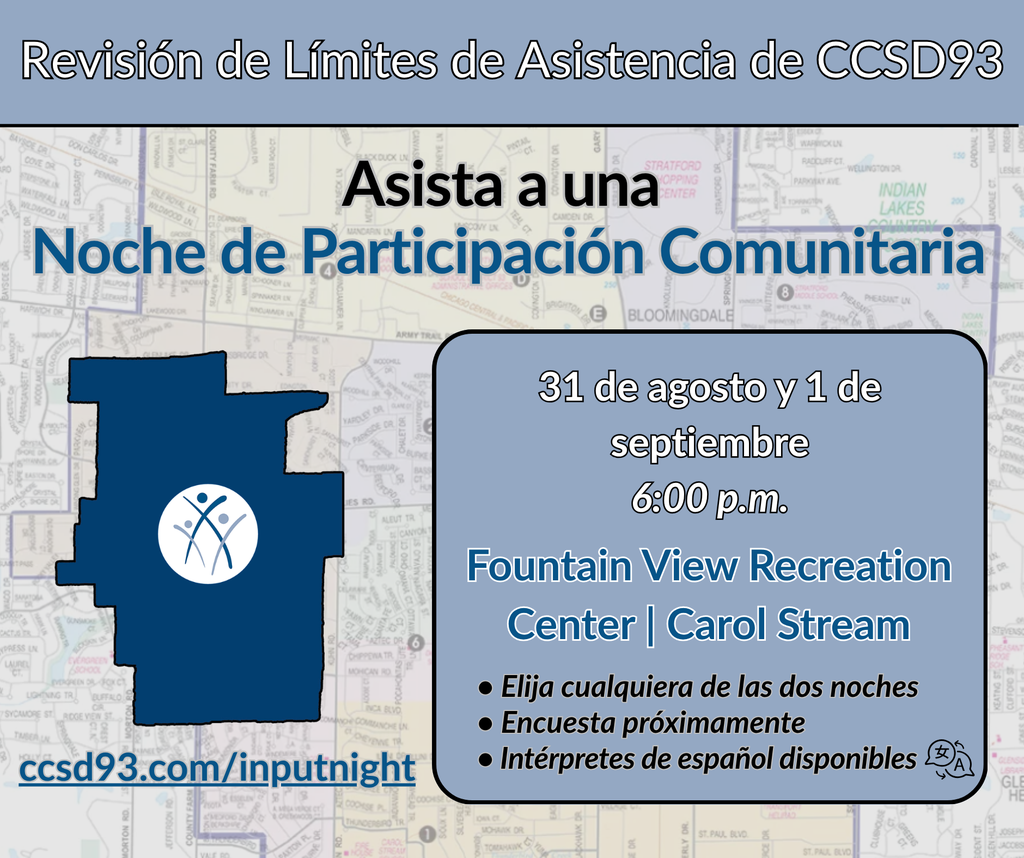
As part of CCSD93’s ongoing boundary review process, we invite parents/guardians, staff and community members to attend one of two identical Community Input Nights to learn more about the work underway and provide feedback on two boundary concepts currently being considered.
Please join us for one of two identical Community Input Nights, which will be held at Fountain View Recreation Center, 910 N Gary Ave. in Carol Stream:
- Monday, August 31, 6:00-7:30 p.m.
- Tuesday, September 1, 6:00-7:30 p.m.
Each evening will begin with approximately 20 minutes of presentation providing background on the boundary review and explaining the two concepts. The remainder of the evening will provide an opportunity for open discussion with CCSD93 administrators and school planning experts from RSP & Associates about the concepts and the considerations surrounding them. Spanish translators will be available.
Please review this message for a reminder of why this work is taking place, background information and maps for both concepts being discussed at the Community Input Nights and more opportunities for you to engage and provide feedback for this process.
Why This Work Is Taking Place
As previously shared, CCSD93 continues to experience disparities in class sizes, resources and access to specialists and programs across our schools. Planned housing developments within our community are also expected to create further enrollment imbalance in the years ahead.
Through this review, our goal is to provide greater equity in learning spaces, resources and student opportunities across all schools while responsibly maximizing community resources during a time when public school districts across the state and nation are increasingly being tasked to do more with less.
CCSD93 has partnered with RSP & Associates to guide a Boundary Committee composed of representatives from all CCSD93 schools, including parents, staff members and administrators, Board of Education members and representatives from our local park districts and villages.
Two Concepts for Community Consideration
Through its work to date, RSP & Associates and the Boundary Committee have developed two boundary concepts for community consideration.
- Concept 1 includes the retirement of Roy DeShane Elementary School.
- Concept 2 includes the retirement of Elsie Johnson Elementary School.
These concepts are intended to explore different approaches to addressing the enrollment, resource and facility considerations identified through the review. It is critical that our community understands that neither concept represents a final recommendation at this stage. They are being shared now specifically so community feedback can help inform the Boundary Committee’s continued work.
At the bottom of this email, you can find elementary and middle school boundary maps for Concept 1 and Concept 2. Interactive versions of the maps, previous Boundary Committee meeting materials and additional background information are available on RSP & Associates’ CCSD93 Boundary Study webpage. We encourage you to review the maps in advance and attend either Community Input Night to learn more, ask questions and hear perspectives from others in the community.
Additional Opportunities to Learn & Provide Feedback
Whether or not you are able to attend a Community Input Night, there will be additional opportunities to learn about the concepts and provide feedback:
- Watch the presentation: A video recording of one of the identical Community Input Night presentations will be posted to CCSD93’s Boundary Review Webpage at www.ccsd93.com/bc following the events.
- Share your feedback: A community survey will be available through RSP & Associates’ CCSD93 Boundary Study webpage and can be completed during or after the Input Nights. The survey will serve as the primary and most effective way for families, staff and community members to formally share feedback with the Boundary Committee. On Wednesday, September 2, CCSD93 will send a follow-up message to all families and staff with direct links to the survey and presentation video.
- Stay informed: CCSD93’s Boundary Review webpage will continue to serve as the district’s central source for updates, including the forthcoming Community Input Night video, implementation timeline and previous district communications. From there, you can also access RSP & Associates’ site for the forthcoming survey, interactive maps, previous meeting presentations and additional materials for review.
Feedback gathered through these opportunities will help inform the Boundary Committee’s continued discussions and any potential recommendations. Any resulting recommendations that could impact student enrollment boundaries would be presented to the Board of Education this fall and would not take effect until the 2027-28 school year, at earliest.
We appreciate your engagement as we pursue a thoughtful and community-informed approach focused on equitable opportunities for CCSD93 students and responsible stewardship of community resources.
Sincerely,
David H. Hill, Ed.D.
Superintendent
Community Consolidated School District 93
Concept 1 & Concept 2 Boundary Maps
Estimada comunidad de CCSD93,
Como parte del proceso continuo de revisión de límites del CCSD93, invitamos a padres/tutores, personal y miembros de la comunidad a asistir a una de las dos Noches de Participación Comunitaria idénticas para obtener más información sobre el trabajo en curso y brindar comentarios sobre dos conceptos de límites que se están considerando actualmente.
Les invitamos a participar en una de las dos Noches de Participación Comunitaria, que se celebrarán en el Centro Recreativo Fountain View, ubicado en 910 N Gary Ave. en Carol Stream:
- Lunes 31 de agosto, de 18:00 a 19:30 horas.
- Martes 1 de septiembre, de 18:00 a 19:30 horas.
Cada sesión comenzará con una presentación de aproximadamente 20 minutos que brindará información general sobre la revisión de límites y explicará ambos conceptos. El resto de la sesión ofrecerá la oportunidad de dialogar abiertamente con los administradores del CCSD93 y expertos en planificación escolar de RSP & Associates sobre los conceptos y las consideraciones relacionadas. Habrá intérpretes de español disponibles.
Por favor, revise este mensaje para recordar por qué se está llevando a cabo este trabajo, obtener información de contexto y mapas de ambos conceptos que se están debatiendo en las Noches de Participación Comunitaria, así como más oportunidades para que usted participe y aporte sus comentarios sobre este proceso.
Por qué se está llevando a cabo este trabajo.
Como ya se ha mencionado, el distrito escolar CCSD93 sigue experimentando disparidades en el tamaño de las clases, los recursos y el acceso a especialistas y programas en todas nuestras escuelas. Se prevé que los proyectos de vivienda planificados en nuestra comunidad también generen un mayor desequilibrio en la matrícula en los próximos años.
Mediante esta revisión, nuestro objetivo es proporcionar una mayor equidad en los espacios de aprendizaje, los recursos y las oportunidades para los estudiantes en todas las escuelas, maximizando al mismo tiempo de manera responsable los recursos de la comunidad en un momento en que los distritos escolares públicos de todo el estado y del país se ven cada vez más obligados a hacer más con menos.
El distrito escolar CCSD93 se ha asociado con RSP & Associates para guiar a un Comité de Límites compuesto por representantes de todas las escuelas de CCSD93, incluidos padres, personal y administradores, miembros de la Junta de Educación y representantes de nuestros distritos de parques y pueblos locales.
Dos conceptos para la consideración de la comunidad
A través de su trabajo hasta la fecha, RSP & Associates y el Comité de Límites han desarrollado dos conceptos de límites para que la comunidad los considere.
- Concepto 1incluye la jubilación de la escuela primaria Roy DeShane.
- Concepto 2Incluye la jubilación de la escuela primaria Elsie Johnson.
Estos conceptos tienen como objetivo explorar diferentes enfoques para abordar las consideraciones sobre matrícula, recursos e instalaciones identificadas a través de la revisión.Es fundamental que nuestra comunidad comprenda que ninguno de los dos conceptos representa una recomendación definitiva en esta etapa.Se comparten ahora específicamente para que los comentarios de la comunidad puedan ayudar a orientar el trabajo continuo del Comité de Límites.
Al final de este correo electrónico, encontrará mapas de límites de escuelas primarias y secundarias para el Concepto 1 y el Concepto 2. Las versiones interactivas de los mapas, los materiales de reuniones anteriores del Comité de Límites y la información de antecedentes adicional están disponibles enPágina web del estudio de límites del CCSD93 de RSP & AssociatesLes animamos a revisar los mapas con antelación y a asistir a cualquiera de las Noches de Participación Comunitaria para obtener más información, hacer preguntas y escuchar las perspectivas de otros miembros de la comunidad.
Oportunidades adicionales para aprender y brindar retroalimentación.
Tanto si puede asistir a una Noche de Participación Comunitaria como si no, habrá oportunidades adicionales para conocer los conceptos y dar su opinión:
- Vea la presentación:Se publicará una grabación de video de una de las presentaciones idénticas de la Noche de Participación Comunitaria en la página web de Revisión de Límites de CCSD93 enwww.ccsd93.com/bctras los acontecimientos.
- Comparta su opinión:Se podrá acceder a una encuesta comunitaria a través dePágina web del estudio de límites del CCSD93 de RSP & Associatesy puede completarse durante o después de las Noches de Recopilación de Información. La encuesta servirá como la principal y más eficaz manera para que las familias, el personal y los miembros de la comunidad compartan formalmente sus opiniones con el Comité de Límites.El miércoles 2 de septiembre, el distrito escolar CCSD93 enviará un mensaje de seguimiento a todas las familias y al personal con enlaces directos a la encuesta y al vídeo de presentación.
- Manténgase informado: Página web de revisión de límites del CCSD93seguirá sirviendo como la fuente central del distrito para actualizaciones, incluido el próximo video de la Noche de Participación Comunitaria, el cronograma de implementación y las comunicaciones anteriores del distrito. Desde allí, también puede accederSitio web de RSP & AssociatesPara la próxima encuesta, se incluyen mapas interactivos, presentaciones de reuniones anteriores y materiales adicionales para su revisión.
Los comentarios recabados a través de estas iniciativas servirán de base para las deliberaciones del Comité de Límites y para la formulación de posibles recomendaciones. Cualquier recomendación que pudiera afectar los límites de matrícula estudiantil se presentará a la Junta de Educación este otoño y no entrará en vigor hasta el año escolar 2027-28, como muy pronto.
Agradecemos su participación mientras buscamos un enfoque reflexivo y basado en la comunidad, centrado en brindar oportunidades equitativas a los estudiantes del CCSD93 y en la administración responsable de los recursos de la comunidad.
Atentamente,
David H. Hill, Doctor en Educación.
Superintendente
Distrito Escolar Consolidado Comunitario 93
Mapas de límites: Concepto 1 y Concepto 2
Save the Date for CCSD93 Boundary Review Community Input Nights 8/31 & 9/1 - 8/7/26 (Sent via Enews)
|

|
|

Planning for the Future: CCSD93 Boundary Review Process Begins - 7/1/26
July 1, 2026
Dear CCSD93 Community,
As shared in my May update to families, CCSD93 has begun a comprehensive review of our attendance boundaries to help ensure equitable opportunities for students while responsibly maximizing community resources for years to come. This message is to update you on the work completed thus far and to share what comes next.
Board of Education Establishes Framework for Boundary Review
In May, the Board of Education participated in a series of one-on-one meetings with school planning experts RSP & Associates, followed by a June workshop to establish the framework that will guide the boundary review process. During these discussions, the Board approved a set of guiding principles that emphasize:
- Maximizing the efficient use of our existing school facilities while remaining fiscally responsible.
- Planning for future enrollment and residential growth.
- Providing equitable access to educational opportunities, programs and resources for all students.
- Respecting neighborhoods and community identity whenever possible while balancing broader district needs.
- Considering natural boundaries, transportation and other practical factors when evaluating attendance areas.
These guiding principles will serve as the foundation for the committee's work throughout the coming months. The Board also established the boundary criteria that will be prioritized as future scenarios are evaluated, ensuring the committee's work remains focused on the district's long-term goals.
Boundary Committee Begins Its Work
Last week, the Boundary Committee held its first meeting to build a common understanding of the process, review district enrollment information and begin identifying the factors that will guide the review. No boundary proposals were presented or considered during this meeting. Instead, the committee focused on understanding the data and identifying the factors that should guide any future recommendations.
Committee Priorities
Although the committee includes parents, staff members, Board of Education members and community leaders representing different schools and perspectives, they expressed priorities that closely aligned with the Board of Education's guiding principles. Committee members also emphasized several priorities, including:
- A shared commitment to the Board's guiding principles, particularly providing equitable opportunities for students, planning for the long term and making responsible use of district resources.
- Providing greater consistency in student access to resources and programs across all schools.
- Creating a process that provides stability and clarity for families.
- Minimizing disruption for students and families whenever possible.
What the Committee Reviewed
The committee reviewed enrollment projections and demographic trends showing that overall district enrollment is expected to remain relatively stable in the years ahead, while enrollment patterns continue to shift between grade levels, creating differences in building utilization that warrant thoughtful long-term planning.
Committee members then participated in a facilitated brainstorming activity using the district's current elementary attendance boundaries. The activity was intended to identify areas for further analysis, not propose new boundaries. Several considerations came to the forefront, including:
- Long-term facility utilization, including whether school retirement (closing a school and redistributing its attendance area) should be analyzed alongside other long-term facility options.
- The use of natural boundaries, such as major roads.
- Keeping neighborhoods together whenever possible.
- The impact of areas with higher student density on equitable boundary design.
- Balancing enrollment between schools experiencing capacity pressures and those with significant available space.
- The age and condition of district facilities.
These discussions were intended to identify considerations, not make decisions. The committee's discussion will help inform the additional analysis RSP & Associates conducts before the next meeting.
Looking Ahead: Timeline & Community Input
This work continues throughout the summer and fall, with additional committee meetings and opportunities for community engagement before any recommendations are developed. Upcoming milestones are highlighted in the timeline graphic at the top of this website and include:
- Three additional Boundary Committee meetings this summer and fall.
- Community Input Nights on August 31 and September 1.
- A community survey following the public input sessions.
- Presentation of any resulting recommendations to the Board of Education for consideration this fall.
We remain committed to providing families, staff and our community with updates throughout this process. For additional resources, including links to meeting materials, visit the Boundary Committee Resource Website at the top of this page.
Thank you for your partnership as we continue this important work on behalf of all CCSD93 students.
Sincerely,
David H. Hill, Ed.D.
Superintendent
Community Consolidated School District 93
Updated CCSD93 Boundary Review Process Begins This Summer - 5/27/26
May 27, 2026
Dear CCSD93 Community,
As CCSD93 prepares to begin an updated boundary review process this summer, this message is intended to provide you with an overview of why this work is taking place, what you can expect in the months ahead, opportunities for community engagement and the timeline for this effort.
Why This Boundary Review is Taking Place
CCSD93 continues to experience disparities in class sizes, resources and access to specialists and programs across our schools. In addition, planned housing developments within our community are expected to create further enrollment imbalance in the years ahead.
As we look toward the future, our goal is to provide greater equity in learning spaces, resources and student opportunities across all schools while responsibly maximizing community resources. This comes at a time when public school districts across the state and nation are increasingly being tasked to do more with less.
During the winter of this school year, CCSD93’s Board of Education considered a proposal intended to address some of these concerns. Ultimately, the Board determined that a more comprehensive and systematic review of district boundaries would be the most responsible path forward.
Boundary Review Process Overview
To support this work, CCSD93 has partnered with school planning experts RSP & Associates and established a Boundary Committee to conduct a comprehensive analysis of enrollment trends, community data and long-term district needs. The following information outlines how the boundary review process will be organized and carried out over the coming months:
- RSP & Associates has begun examining district enrollment trends, demographic information and community data in preparation for the committee’s work.
- The Boundary Committee has been formed and includes parents from all CCSD93 schools, staff members and administrators, Board of Education members and representatives from our local park districts and villages.
- Beginning this summer, Boundary Committee members will work alongside RSP & Associates to analyze information and consider potential future recommendations.
- CCSD93 will maintain a webpage at www.ccsd93.com/bc and continue providing updates throughout the process.
Opportunities for Community Input
Community input will play an important role throughout this work. CCSD93 is committed to providing families and community members with multiple opportunities to learn about the review, share feedback and remain informed as it moves forward.
- Families and community members will be invited to participate through Community Input Nights, surveys and ongoing district communications.
- Feedback gathered throughout the process will help inform committee discussions and potential recommendations.
Timeline
The following timeline outlines key milestones in the boundary review process. CCSD93 will continue providing updates and additional details to families and staff members throughout this work.
- June-September 2026: Four Boundary Committee meetings will be held.
- August 31 & September 1, 2026: Community Input Nights will be held from 6:00-7:30 p.m. at Fountain View Recreation Center in Carol Stream.
- September 2026: A community survey will be shared with all families following the Community Input Nights.
- Late Fall 2026: Any resulting recommendations that could impact student enrollment boundaries would be presented to the Board of Education.
- 2027-28 School Year: Any school board approved boundary adjustments would take effect for the 2027-28 school year, at earliest.
- Ongoing: Additional information and updates will continue to be shared throughout this school year and into next year.
We appreciate your partnership as we engage in this process focused on providing equitable opportunities for all CCSD93 students while remaining responsible stewards of community resources. If you have questions, please contact reply@ccsd93.com or visit www.ccsd93.com/bc for updates.
Sincerely,
David H. Hill, Ed.D.
Superintendent
Community Consolidated School District 93